wiseed

Study and exams

Completion of study

A thesis is one thing with six steps — topic, approved, handed in, committee, defended, graduated — each with its date, so anyone can see where every thesis stands. When the graduation is recorded, the diploma and the Diploma Supplement are issued together: one number, two verification codes, nothing ever rewritten.
  • Every thesis at its step, on one list
  • The diploma and the supplement in one action
  • A QR code that leads to a public check

What it does

  • Mentors and topics: each mentor’s areas and limit of students, and the topics they offer, which a student can take in the portal.
  • The topic proposal is written by the student in the student portal or typed in by the office, with the school’s own proposal fields. Its validity and extensions follow the school’s rules.
  • One page per thesis: the step bar, the topic and its approval, the validity, the work and its files, the committee, the defences, the graduation and the history.
  • The work is uploaded by the student or the office and kept with its SHA-256 checksum, every version handed in.
  • Grades and languages are the school’s. A thesis or defence grade comes from the school’s own grade list, and a thesis may be written in any language the school writes documents in.
  • The register of every diploma and supplement issued: number, holder, date, verification code, valid or annulled, and the PDFs.
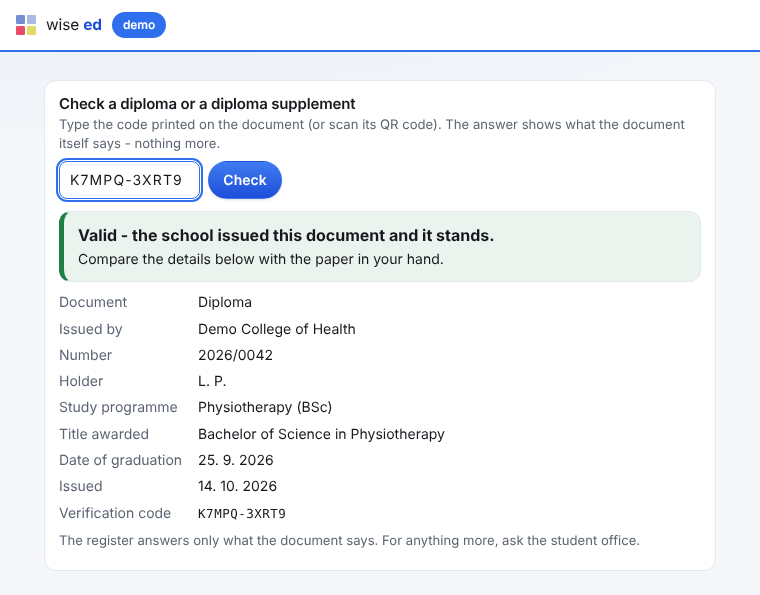
The public check of a diploma: the code typed in, the answer that the document is valid, and what the diploma says - school, number, holder’s initials, programme, title, dates
The public check a QR code on the diploma leads to. It shows what the document says, nothing more.

From the topic to the diploma

  1. The topic is proposed and approved

    The student proposes a topic or takes one a mentor offers; the decision on it is a status with a date and a number, not a printed form.

  2. The work is handed in

    With its file, while the topic is valid. The student sees every step of their thesis, with the days of validity left.

  3. The committee is named and the defence held

    The committee and its chair against the school’s rule, the defence with its date and grade. Before a defence is scheduled, the degree audit names anything still open — credits short, a required subject not passed.

  4. The graduation is recorded

    On the thesis page. The audit asks once more, and the office continues with a reason where something is open.

  5. The diploma and the supplement are issued

    “Issue the diploma and the supplement” is one button: one number from the school’s sequence, without gaps, two entries in the register, two verification codes.

The diploma and the Diploma Supplement

  • The Diploma Supplement is the European one, on the model of the European Commission, the Council of Europe and UNESCO: its eight sections in order, every line in the school’s two document languages — its own and a widely spoken one.
  • No point left blank. What the records hold is filled from them; what they cannot hold is a school text with a default that explains itself. A default text nobody at the school has read yet is asked about when a supplement is issued with it.
  • Printed on the school’s own security paper. Every field of the diploma has its position, so a school whose paper already carries its crest and the word “Diploma” switches those fields off; a test sheet checks the positions before the first real print.
  • Duplicates and corrections. A duplicate keeps the number and is marked as one; a correction is a new issue with a new number. Both name their reason, and the document they replace is annulled — never edited, never deleted.
  • A public check. The QR code on each document leads to a page that needs no sign-in and says whether the document is valid or annulled, with what it says.

Rules that ask

The school’s rules for theses are settings in plain words, and the unusual is asked about, not refused.

  • Asked, then done when confirmed: a mentor at their limit, a topic extended more often than the rule allows, work handed in after the topic expired, a committee smaller than the rule or with the mentor in the chair, a graduation date without a passed defence.
  • Refused only what cannot be stored: a topic with no title, a grade not on the school’s scale, a step on a cancelled thesis (reopen it first, with a reason).
  • The student does only what they may: propose, withdraw a proposal nobody has started on, hand in the work. A button is shown only where the school allows the step.

Not yet

  • A national repository of diplomas, where a country keeps one (in Slovenia, the repository the higher-education act provides for), is not connected. The graduation itself does reach the national register, as the event that ends a study, through national reporting.

Questions about the thesis and the diploma

Can the student see where their thesis is?

Yes. In the portal, the six steps with their dates and states, the mentor, the topic’s validity, what the commission asked to change, the committee and the defence — and after graduation the numbers and verification codes of the diploma and the supplement.

Can we print on our own security paper?

Yes. Every field has its position on the paper, and the school switches off what its paper already carries. A test sheet shows where everything falls.

What if a diploma was issued with a mistake?

A correction is issued: a new document with a new number and its reason, and the wrong one is annulled. The public check then says it is annulled. A lost diploma gets a duplicate under the same number.

In which languages is the supplement?

In the school’s document language and a second one, line by line. Its fixed words come in the language itself — a Croatian supplement is headed in Croatian.

Works with

Each module works on its own. These are the ones it does more with.

Exams and grades

Exam records, online grade entry, rules that say why, sign-off and the transcript.

Degree audit

Each student against what the degree asks for, with a what-if and a checkable report.

National reporting

Reporting to the country’s register, batch by batch, every problem in plain words.

See Wise Ed on your own school

Book an online presentation. We will walk through how your student office works today and show you the same job in Wise Ed — with your programmes, not a demonstration dataset.