
Examinations
Exam invigilation and seating
Who is actually in the room. An exam timetable that says when and where is half an exam timetable; the other half is who is supervising, how many of them, and which desk each candidate sits at.
A different office, a different problem
Teaching timetabling and examination scheduling are usually run by different people, and the second is not a special case of the first. A teaching timetable repeats weekly and is optimised for the cohort; an examination timetable happens once, is checked at the level of the individual candidate, and fails publicly.
The vocabulary changes too. The person watching the room is an invigilator in Britain, Ireland and the Gulf, an exam supervisor in Australia and New Zealand, and a proctor in North America. The student sitting the paper is a candidate. Getting this wrong in a procurement document is a reliable way to look like an outsider.
What has to be allocated, in order
- Papers to sessions — respecting the minimum gap between two papers for any one candidate, not just for the cohort.
- Sessions to rooms — by seating capacity under exam conditions, which is not the teaching capacity of the same room.
- Candidates to desks — a seating plan, with desk numbers, and usually a rule about who may not sit adjacent to whom.
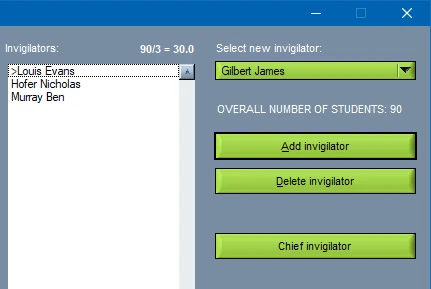
- Invigilators to rooms — by a ratio the institution sets, with a named senior invigilator per room.
- Adjustments — extra time, separate rooms, readers and scribes, each of which changes the room count rather than the seat count.
The ratio is an institutional decision, not a default
Institutions publish their own supervision ratios and they differ: a base number of invigilators per room plus one for every further block of candidates is the common shape, with a higher ratio where adjustments are in play. A system that hard-codes a ratio is a system somebody will be overriding by hand in May.
The same is true of the adjacency rules in a seating plan. Some institutions separate candidates sitting the same paper; some separate candidates from the same programme; some do neither and rely on paper variants.
Where the errors come from
Almost never from the algorithm. They come from capacity figures that were measured for teaching, from a candidate list that was correct three weeks ago, and from an adjustment granted after the seating plan was printed.
The practical defence is that the exam timetable is generated from the same live data as everything else, so a candidate who changes module is picked up from the registrations the next time the session is generated — rather than a row in a spreadsheet somebody has to remember to update.
Where this lives in Wise Timetable
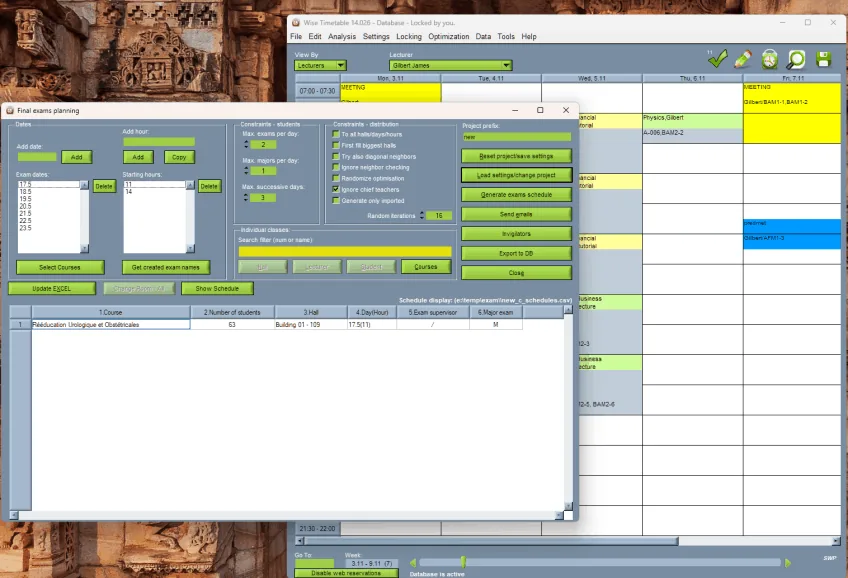
Exam scheduling software covers the allocation, including seating plans, invigilator assignment and student-level clash checking across the whole cohort. Invigilators are picked from the lecturer list, which holds every professor and any administrators entered in it. The wider question of why examination scheduling is a different problem from teaching timetabling is in building an exam timetable.
Want to see this working?
Book a 45-minute online presentation and we will walk through it against your institution's own scheduling problem.