
Examinations
Exam scheduling software
Examination timetabling is a different problem from teaching timetabling, and treating it as a special case of the same thing is why so many institutions end up doing it in a spreadsheet. Wise Timetable has a dedicated module.
- Seating plans
- Invigilator assignment
- Included in the licence
Why examinations are harder than teaching
In a teaching timetable you schedule groups. In an examination timetable you must consider individual students, because every student's combination of modules is potentially unique.
That changes the nature of the clash check entirely. Two papers that no student group shares may still collide for the eleven students taking an unusual elective combination — and those eleven students will find out on the morning of the exam if your system only checks at group level.
Examinations also carry rules that teaching does not: minimum gaps between a student's papers, room capacity computed on seating separation rather than headcount, invigilator ratios, and access arrangements for students with adjustments.
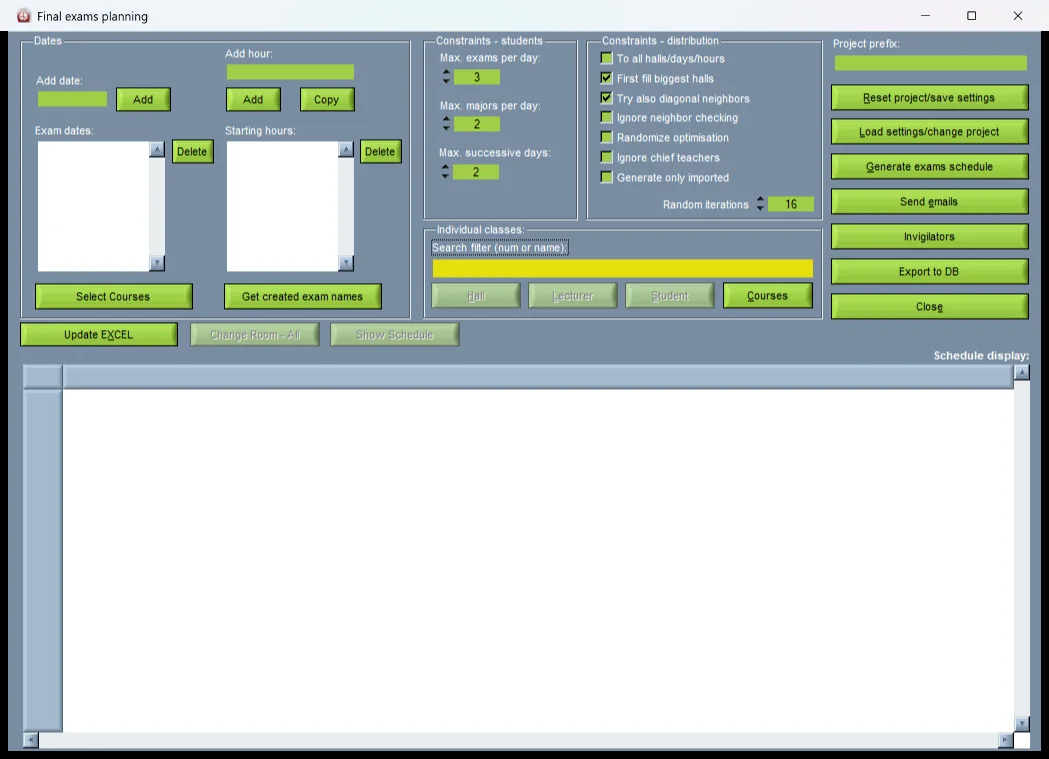
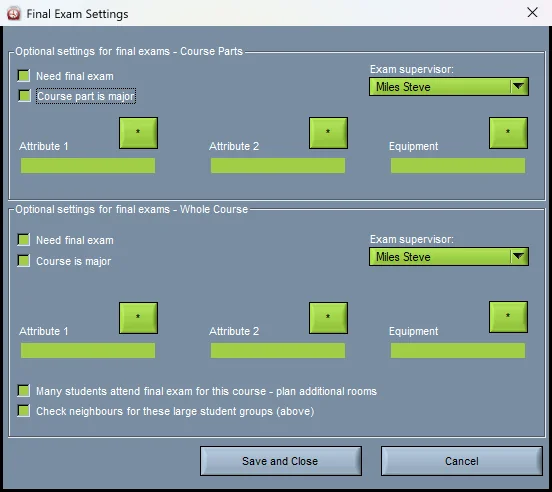
What the module handles
- Student-level clash detection across every module combination
- Seating plans, with separation rules and per-room layouts
- Invigilator assignment against availability and required ratios
- Minimum gaps between a student's consecutive papers
- Room capacity calculated for examination conditions, not lecture conditions
- Multiple examination sessions and resit periods
- Publication to web, mobile apps and personalised student timetables
- Export to PDF and Excel for invigilators and exam officers
Integrated with everything else
Examination scheduling uses the same room inventory, the same student and module data, and the same publishing pipeline as your teaching timetable. Nothing is maintained twice, and an examination cannot be placed in a room that is already committed.
The module is included in a standard licence. Almost everywhere else in this market, exam scheduling is a separately priced extension.
Download the manual
- Planning an examination session (PDF, 21 pages)The whole of an exam session for the people who run one: building the session, allocating candidates to rooms and invigilators to sittings, the constraints an examination period carries that a teaching week does not, and getting the finished schedule out to students. Free, and no form to fill in.
- Per-student generation (PDF, 9 pages)The other half of student-level scheduling: building groups and parallel sections from enrolment data rather than by hand, so that the clash check has real individual students to check against. In production at a faculty of around 2,500 students.
- Wise Timetable User Manual (PDF, 278 pages)The complete desktop manual, examinations included, with every screen illustrated. 19 MB, so it is a download rather than something to read in a browser tab.
- All published manualsEighteen documents and the ISO/IEC 27001 certificate, published openly and none of them behind a form.
Related capabilities
See Wise Timetable on your own data
Book a 45-minute online presentation. We will walk through your institution's scheduling problem, show how Wise Timetable handles it, and answer anything your team wants to test.