
Solutions
Multi-campus timetabling
Scheduling one campus is a constraint problem. Scheduling several is a geography problem, and most systems treat the distance between buildings as somebody else's concern.
Travel time is a hard constraint, not a footnote
The failure mode is familiar: a lecturer finishes at eleven on one site and starts at eleven on another, forty minutes away. The timetable contains no clash by any conventional definition, and it is still impossible. So is the student cohort scheduled with a ten-minute gap between buildings at opposite ends of a campus.
Wise Timetable treats inter-campus travel time as a constraint the generator must respect, in the same way it respects room capacity. A travel conflict is detected during generation rather than discovered by the person who has to make the journey.
One timetable, several views
Each campus needs to see its own schedule without wading through the others. Central administration needs the consolidated picture. Both come from the same underlying timetable, so there is no reconciliation step and no possibility of a site working from a stale copy.
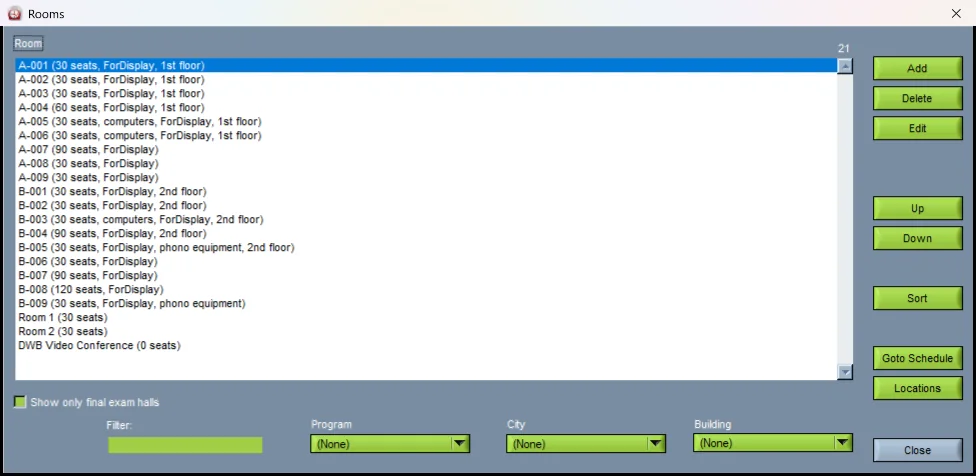
Rooms, laboratories and staff shared across sites are visible to every campus that draws on it. A room booked by one site cannot be allocated by another.
- Unlimited campuses, buildings and rooms under one timetable licence
- Travel time between sites enforced during generation
- Per-campus views alongside a consolidated institutional view
- Shared rooms and staff visible across every site that uses them
- Per-site digital signage driven from the same live data
- Regional cloud distribution where campuses span countries
When sites are genuinely independent
Not every multi-site institution should run one timetable. Where campuses share no rooms, no staff and no modules, and publish separately, licensing them as separate timetables is usually cheaper and always simpler.
The test is whether resources cross the boundary. If they do — even a handful of jointly appointed staff — one timetable is both cheaper and more accurate than two that have to be reconciled. See the pricing model.
See Wise Timetable on your own data
Book a 45-minute online presentation. We will walk through your institution's scheduling problem, show how Wise Timetable handles it, and answer anything your team wants to test.