
Process
The annual timetable cycle
From rollover to publication. Americans call it the schedule build, the British call it the rollover, and Australians call it timetable development — it is the same nine months, and the software occupies a surprisingly small part of it.
The shape of the year
A timetabling office does not build a timetable once. It runs an annual cycle in which the build itself is one stage among six, and the stages that consume the most calendar time are the ones that involve other people.
The cycle looks broadly the same everywhere, which is the useful thing about it: an institution comparing itself to another is comparing the same stages, whatever they are called locally.
The six stages, and what each is called
| Stage | Britain | United States | What actually happens |
|---|---|---|---|
| 1 | Rollover | Roll forward | Last year's structure is copied into next year's database. Rooms, staff and modules carry over; the schedules usually do not. |
| 2 | Data collection | Schedule build, phase 1 | Departments state what they are teaching, to whom, and with which staff. This is the stage that slips. |
| 3 | Constraint collection | Instructor preferences | Availability and unavailability requests come in from staff, usually late and usually by email. |
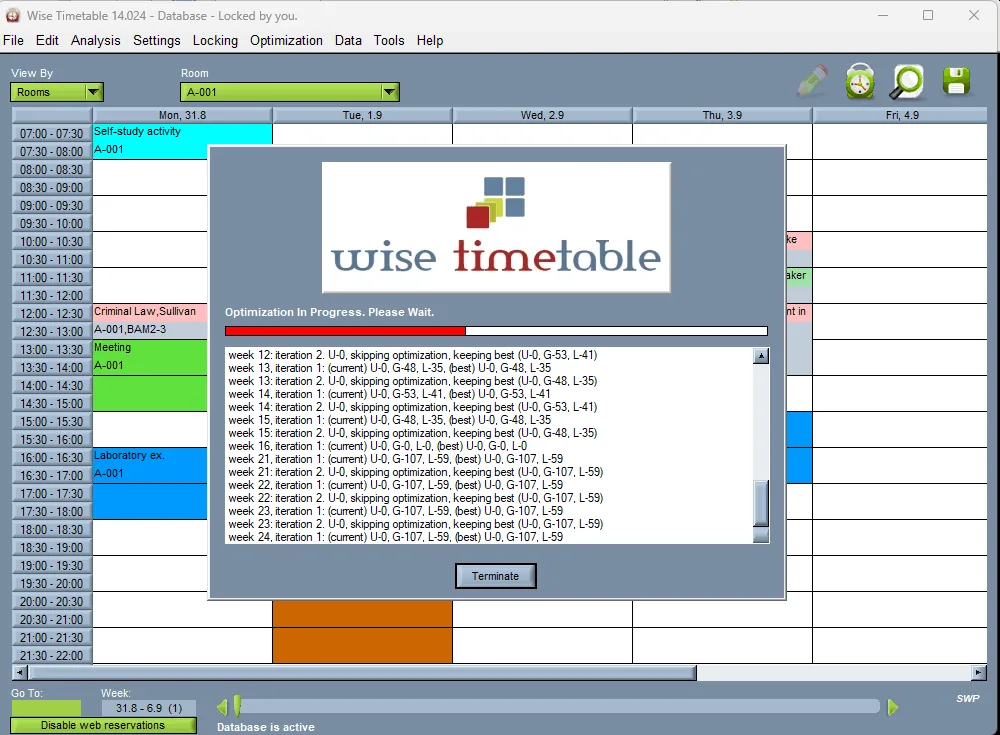
| 4 | Generation | Optimizer run, priority phase | The machine places what it can. Minutes to hours. |
| 5 | Resolution | Manual phase | A person places what the machine could not, and negotiates the rules that made it impossible. |
| 6 | Publication | Schedule of classes published | Students and staff see it. In Britain this is typically committed weeks ahead by policy; Macquarie publishes eight weeks before, ACU four. |
Why stage two dominates
Every institution that has been through this knows the answer and every institution about to buy software hopes it is not true: the generator is fast and the data collection is not. A department that returns its teaching requirements three weeks late moves publication three weeks later, and no amount of optimisation recovers it.
This is why the honest questions to ask a vendor are about stages one to three rather than stage four. Can staff submit their own availability, so it does not arrive as email? Can last year's structure carry forward, so nobody retypes it? Can a department see what it has and has not returned?
Two details that bite
Week patterns. A British academic year is not a continuous run of identical weeks: teaching weeks, reading weeks, assessment weeks and vacations interleave, and the teaching week number is not the ISO calendar week. A rollover that carries the old week ranges into a year whose term dates have moved produces a timetable that is right in shape and wrong by a week.
Terms that are not years. Australian institutions roll per study period, two or more times a year, and American ones per term. An annual cycle is a British assumption, and a system that only understands one rollover a year fails quietly in those markets.
Where this lives in Wise Timetable
The transition is one screen: moving to the next academic year seeds next year's database from this one, keeps the rooms and lecturers, and drops last year's schedules. Lecturer availability is collected from the lecturers themselves rather than by email, and importing data covers the departmental returns.
A realistic timeline for a first year, with the stages that dominate flagged honestly, is in how long it takes to get a timetable live.
Want to see this working?
Book a 45-minute online presentation and we will walk through it against your institution's own scheduling problem.