
Operations
Improving room utilisation
Teaching space is one of the two most expensive resources a university controls, and the timetable is what determines how well it is used. Most institutions have never measured it.
Before you improve it, measure it
This article is about raising utilisation. How the figure is actually produced — frequency times occupancy, the survey that collects it and what a survey week does and does not prove — is in space utilisation surveys.
Two different numbers, frequently confused
Frequency is what proportion of available hours a room is booked at all. Occupancy is what proportion of its seats are filled when it is booked. Institutions quote one and mean the other, and the distinction matters enormously.
A lecture theatre booked forty hours a week with twelve students in a two-hundred-seat room has excellent frequency and terrible occupancy. The corrective action for each is completely different: low frequency is a scheduling problem, low occupancy is usually a room-allocation problem.
Multiply them and you get utilisation, which is the number capital planning committees actually want.
What the figures usually reveal
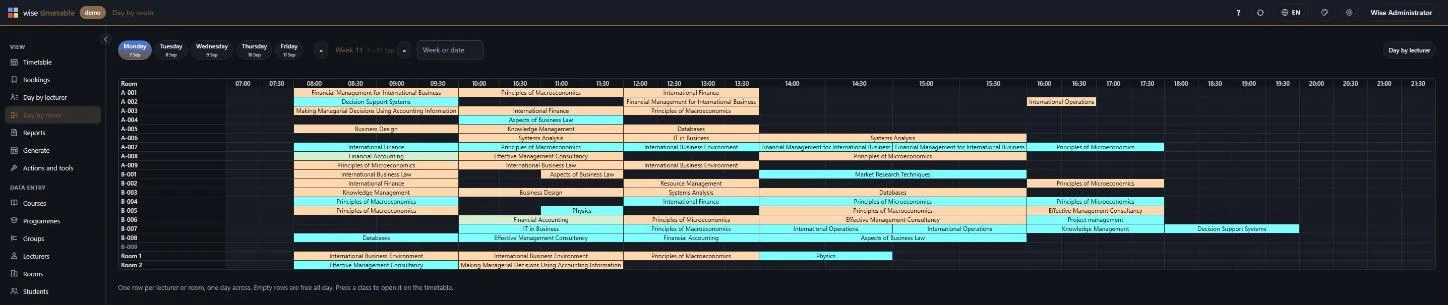
- A pronounced midday peak. Almost everything is scheduled between ten and three, and the estate sits idle either side. The constraint is rarely the rooms; it is preference.
- Systematic room oversizing. Groups placed in the largest available room rather than the smallest adequate one, because that is the path of least resistance for whoever allocated it.
- Departmental hoarding. Rooms nominally belonging to a department, blocked out and unused, invisible to everyone else.
- Friday collapse. Utilisation on Friday running well below the rest of the week, which is a policy question rather than a scheduling one.
- A handful of catastrophic rooms. Two or three spaces nobody wants, for reasons nobody has written down, dragging the average down.
What timetabling can and cannot fix
Scheduling can flatten the midday peak by spreading teaching across extended working hours, and it can fix systematic oversizing automatically by matching group size to the smallest adequate room. Both are straightforward once the constraint set permits them.
It cannot fix a room that is genuinely unfit, and it cannot resolve a political decision about whether teaching may be scheduled at eight in the morning or after six in the evening. What it can do is quantify the cost of those decisions, which changes the conversation.
The most useful output of a utilisation exercise is frequently the discovery that a proposed new building is not needed — that the existing estate would be sufficient if teaching were distributed differently. That is a finding worth considerably more than the software cost.
Measuring it
Utilisation reporting has to come from the live timetable rather than from a manual survey, both because surveys are expensive and because they are out of date immediately. Wise Timetable reports utilisation by room, building, campus and time of day, exportable for committee papers.
Want to see this working?
Book a 45-minute online presentation and we will walk through it against your institution's own scheduling problem.